AI & Artificial Intelligence
What Are AI Agents? A Practical Guide for Business Owners

RP Nainwal · Senior Software Engineer | Technology & AI
Published 4 min read
What Are AI Agents? A Practical Guide for Business Owners
Artificial intelligence is changing the way businesses operate. From writing emails and analysing information to supporting customers, AI tools are becoming part of everyday business activities.
But a new development is taking this further: AI agents.
Unlike traditional AI tools that mainly respond to questions or generate content, AI agents can work towards specific goals, use tools, perform multiple steps, and help complete tasks with less manual involvement.
So, what exactly are AI agents, and how can businesses benefit from them?
1. What Are AI Agents?
An AI agent is a software system that uses artificial intelligence to understand a goal, make decisions, and perform actions to achieve that goal.
Think of an AI agent as a digital assistant that can do more than simply answer questions.
For example, a traditional AI chatbot might help you write a customer response. An AI agent could potentially receive a customer enquiry, understand the request, retrieve relevant information from your business system, prepare a response, and send it after the required approval.
The key difference is that an AI agent can work through a sequence of tasks rather than responding to just one instruction.
2. How Do AI Agents Work?
Most modern AI agents combine several components:
- AI Model: Understands instructions, processes information, and helps make decisions.
- Instructions: Define the agent's role, objectives, and boundaries.
- Tools: Allow it to interact with external systems, APIs, databases, or software.
- Memory and Context: Help maintain relevant information during a task or across interactions.
- Action and Feedback: Allow the agent to perform tasks and evaluate the results.
For example, a sales follow-up agent might identify customers who need attention, retrieve their previous interactions, prepare personalised follow-up messages, and request approval before sending them.
The exact capabilities depend on the tools, permissions, and safeguards provided to the agent.
3. AI Assistants vs AI Agents: What's the Difference?
Although these terms are sometimes used interchangeably, there is a useful distinction.
AI Assistants generally help users by answering questions, generating content, explaining information, or suggesting actions.
AI Agents can go a step further by planning and executing a sequence of actions to achieve a defined objective.
For example:
- AI Assistant: "Write a follow-up email for this customer."
- AI Agent: "Review pending customer enquiries, prepare suitable follow-up emails, and send them after approval."
This distinction is not absolute. Many modern AI systems combine assistant and agent capabilities.
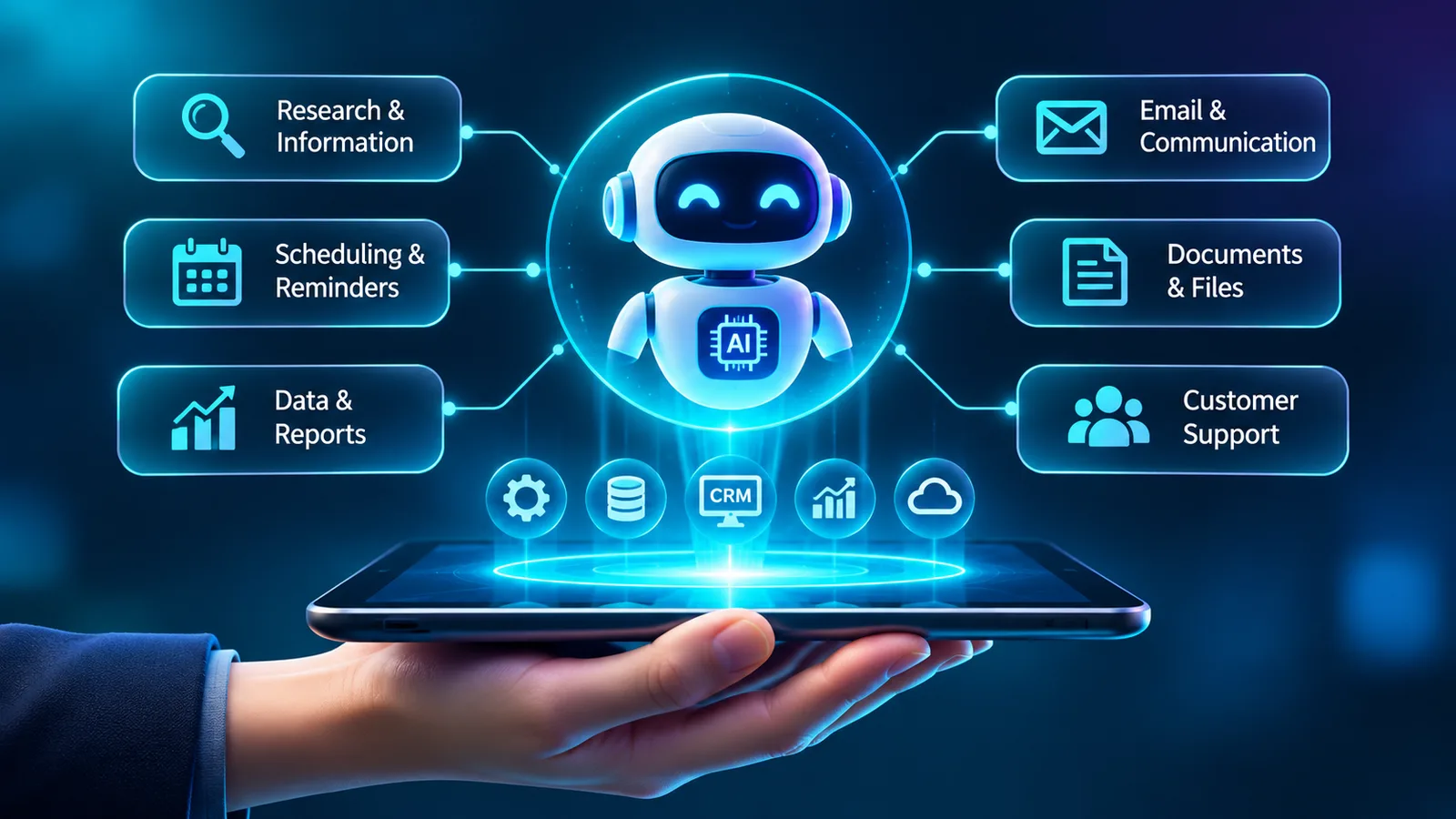
4. Practical Uses of AI Agents in Business
AI agents can support different departments and business processes.
Customer Support
Agents can answer common questions, retrieve order information, classify support requests, and route complex issues to human staff.
Sales and Lead Management
They can organise incoming leads, collect relevant information, update CRM records, and prepare follow-up activities.
Marketing
Agents can assist with content research, campaign planning, social media drafts, and performance analysis.
Business Operations
They can help process routine requests, organise documents, generate reports, and coordinate repetitive workflows.
Finance and Administration
With appropriate controls, agents can assist with invoice data extraction, expense categorisation, and financial report preparation.
These are practical application areas, not guarantees of fully autonomous operation. Human review is important, particularly when financial, legal, or customer-impacting decisions are involved.
5. Benefits and Limitations
AI agents offer several potential advantages:
- Reduce repetitive manual work.
- Improve response times.
- Support employees with information and task execution.
- Connect different business applications.
- Help businesses scale routine processes.
However, they also have limitations.
AI agents can misunderstand instructions, produce incorrect information, or take inappropriate actions if their permissions and workflows are poorly designed. They may also introduce data privacy, security, and operational risks.
Businesses should therefore start with clearly defined tasks, restrict access to sensitive systems, maintain activity logs, and require human approval for important actions.
6. How Can a Business Get Started?
You do not need to automate your entire business at once.
A practical starting approach is:
- Identify one repetitive business task that consumes employee time.
- Define exactly what the AI agent should and should not do.
- Connect only the tools and information it needs.
- Test it with real-world scenarios in a controlled environment.
- Introduce human approval for important actions.
- Measure accuracy, time saved, and overall business value.
Start small, evaluate the results, and expand gradually.
7. The Future of AI Agents
AI agents are an important development in the evolution of business software. As AI models, integrations, and automation frameworks improve, businesses will have more opportunities to build systems that can coordinate complex workflows.
The future is not necessarily about replacing every employee with AI. It is about giving people better tools to reduce repetitive work, access information faster, and focus on decisions that require human experience and judgement.
The real opportunity is not simply using AI. It is using AI to make business operations more intelligent, efficient, and connected.